
McKinnon Basketball Association wishes to advise players, coaches, referees and families of several important rule changes that will come into effect across our domestic competitions from Tuesday 1 December 2026.
The changes include updates to how the act of shooting is determined, the introduction of two categories of technical fouls and the replacement of unsportsmanlike fouls with disruptive and flagrant fouls.
To help our basketball community understand these changes, we have provided a breakdown of the key updates below.
Article 15 – Player in the Act of Shooting
Changes have been made to clarify when a player is considered to be in the act of shooting.
Jump Shots and Moving Shots
The act of shooting begins when the player's shoulders and the ball begin moving upwards towards the basket.
A foul will not be considered a shooting foul if the player subsequently passes the ball, moves the ball upwards away from the basket or is not facing the basket when moving the ball upwards.
Drives to the Basket (Continuous Motion)
For players driving towards the basket, the act of shooting begins when the ball is gathered following a dribble or catch and the player continues their shooting motion without interruption.
Illegal contact made before the ball is gathered will not be considered a shooting foul.
Frontcourt Only
Players must be in their offensive frontcourt to be considered in the act of shooting.
The exception is a last-second shot attempted immediately before the expiration of the game clock at the end of a quarter or overtime, or the expiration of the shot clock.
Article 36 – Technical Fouls
Technical fouls will now be separated into two categories, with different consequences depending on the nature of the offence.
Category 1 Technical Foul (TF1)
Examples include:
Disrespectful communication towards referees, opponents or team bench personnel.
Offensive language or gestures.
Baiting, taunting or provoking an opponent.
Obstructing an opponent's vision with hands.
Excessive swinging of elbows without contact.
Flopping or pretending to have been fouled.
Penalty: Two free throws and a frontcourt throw-in for the opposition, with the offending player subject to the sin bin. The foul also counts towards game disqualification.
Category 2 Technical Foul (TF2)
Examples include:
Deliberately delaying the game.
Preventing a prompt throw-in or free throw.
Entering the court late to start a half.
Hanging on the ring unnecessarily.
Defensive goaltending during the last or only free throw.
Penalty: Two free throws and a frontcourt throw-in for the opposition. There is no sin bin penalty and the foul does not count towards game disqualification.
Article 37 – Disruptive Fouls (DI)
The introduction of disruptive fouls forms part of the replacement of the previous unsportsmanlike foul classification.
A disruptive foul generally relates to tactical or unnecessary contact intended to interrupt the progress of the game without legitimately playing the ball.
Criteria include:
Unnecessary contact to stop an opponent's progress in transition.
Tactical fouling to stop the clock towards the end of a quarter or overtime without legitimately playing the ball.
Contact from behind or the side on an opponent progressing towards the basket with no defenders ahead.
Penalty: Two free throws and a frontcourt throw-in for the opposition. Disruptive fouls do not result in a sin bin penalty or count towards game disqualification.
Referee Signal: The referee raises a closed fist before extending two fingers.
Article 38 – Flagrant Fouls (FL)
Flagrant fouls are the second new classification replacing unsportsmanlike fouls and relate to illegitimate, excessive, reckless or dangerous contact.
Criteria include:
Illegal contact that is not a legitimate basketball play.
Reckless, violent or dangerous actions that cause or could cause injury.
Excessive, hard contact while playing the ball or an opponent.
Penalty: Two free throws and a frontcourt throw-in for the opposition, with the offending player subject to the sin bin. The foul also counts towards game disqualification.
Referee Signal: The referee grasps their wrist above their head.
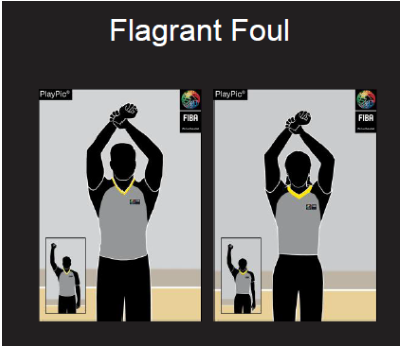
Disruptive and Flagrant Fouls During the Act of Shooting
Where a disruptive or flagrant foul occurs during the act of shooting, the following free throw penalties apply:
Successful shot: One additional free throw.
Unsuccessful two-point shot: Two free throws.
Unsuccessful three-point shot: Three free throws.
In each instance, the opposition will also receive a frontcourt throw-in following the free throws.
Sin Bin and Game Disqualification
The introduction of these new foul classifications also changes which offences result in a sin bin penalty and count towards game disqualification.
The following fouls result in a sin bin penalty and count towards game disqualification:
Category 1 Technical Foul (TF1)
Flagrant Foul (FL)
The following fouls do not result in a sin bin penalty or count towards game disqualification:
Category 2 Technical Foul (TF2)
Disruptive Foul (DI)
A player will be automatically ejected from the game if they receive any of the following:
Two Category 1 Technical Fouls.
Two Flagrant Fouls.
One Category 1 Technical Foul and one Flagrant Foul.
Further Information
McKinnon Basketball encourages all players, coaches and families to familiarise themselves with these changes ahead of their introduction on Tuesday 1 December 2026.
Our referees will be implementing these changes across our domestic competitions and we ask that all members of our basketball community remain respectful and supportive of our officials throughout the transition.
A detailed overview of the rule changes, including examples, penalties and updated referee signals, is available in the information sheet below.